
Jul - Aug 2026
B2B
Workflow
Internal system
Building scalable product operations for international growth
Designing a PIM system to streamline e-commerce product workflows
My role
Mapped core e-commerce workflows
Defined how operational systems, data and responsibilities should connect
Deliverables
Designing a PIM solution for product content, attributes, localisation and multi-market publishing workflows
Challenges
Balancing operational needs, system complexity and implementation effort while keeping the solution practical and scalable
Project process
1
Define the business context and operational needs
2
Map information flows and system ownership
3
Develop key workflows and use cases
4
Prototype with the assistance of AI tools
This is a concept project built on my previous experience designing and working with e-commerce internal systems. I created a fictional outdoor retailer and business scenario to explore how product operations could be structured and scaled across multiple markets.
Define the business context and operational needs
Kamzik Outdoors is a Czech outdoor retailer with around 30 years of operation, aiming to expand further into Central and Eastern European markets. Its product range covers hiking, camping, climbing, running, cycling and winter sports. Besides the Czech Republic as its primary market, Kamzik currently operates e-commerce businesses in Slovakia, Poland and Hungary as secondary markets.
With around 22,000 active product models and 75,000 sellable SKUs, the company works with more than 300 brands from around 180 suppliers and processes approximately 60,000 orders per month. Before entering its next stage of expansion, the company identified several key operational challenges.
Product management for scaling operations
The existing internal systems were originally designed for a smaller business and gradually became difficult to scale with growing product volume and additional markets. Marketing, logistics and e-commerce teams often relied on duplicated product data, which increased manual work and created inconsistencies across teams and countries.
Localisation management
Customer behaviour varied significantly across markets. Czech customers showed a substantially lower bounce rate than users in Slovakia, Hungary and Poland, while the primary market also generated significantly stronger revenue.
Similar patterns can be observed across other multi-market e-commerce businesses, raising an important question for Kamzik's expansion: how should product content and localisation be managed and optimised for different markets instead of simply being duplicated and translated?
Marketing management
Launching campaigns across multiple countries required repetitive manual work, while product assets and marketplace information were managed separately across different tools.
For the next stage of growth, the focus should shift towards reducing repetitive operational work through better system integration and affordable automation, allowing marketing teams to spend more time analysing effective local channels, campaigns and content.
Map the main information flows between systems
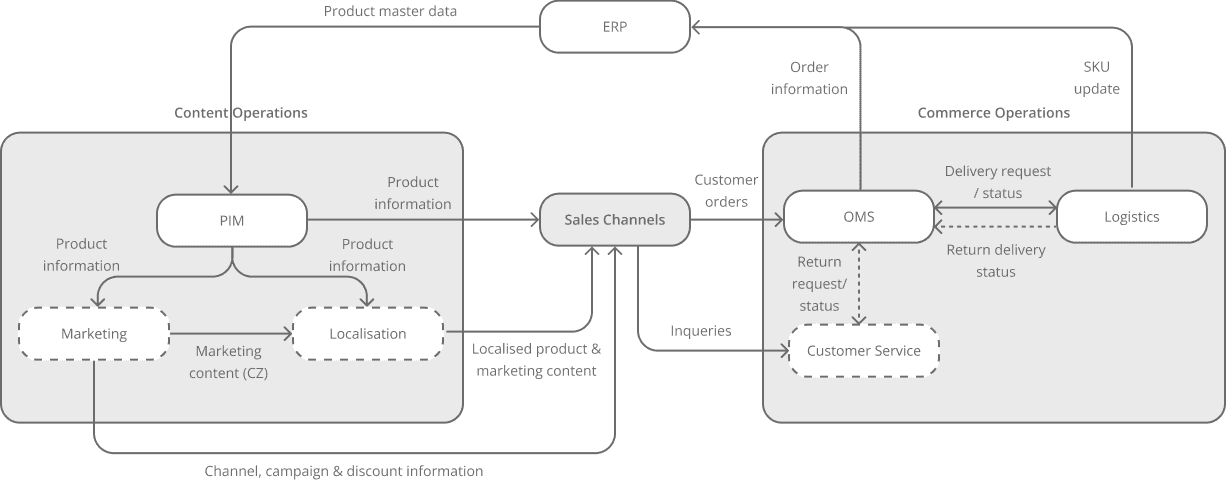
To design efficient internal systems and their interactions, I first focused on establishing clear data flows and system responsibilities. I identified and differentiated the ownership of each system before mapping their interactions. The overall structure includes ERP as the common system; Product Information Management, Order Management and Logistics as core systems; and Customer Service, Marketing and Localisation as supporting systems. With clearly defined responsibilities for each system, it became easier to understand how information should flow and where interactions should be triggered.
Define data ownership for each system

Map primary data flows
Develop the primary workflows for e-commerce operations
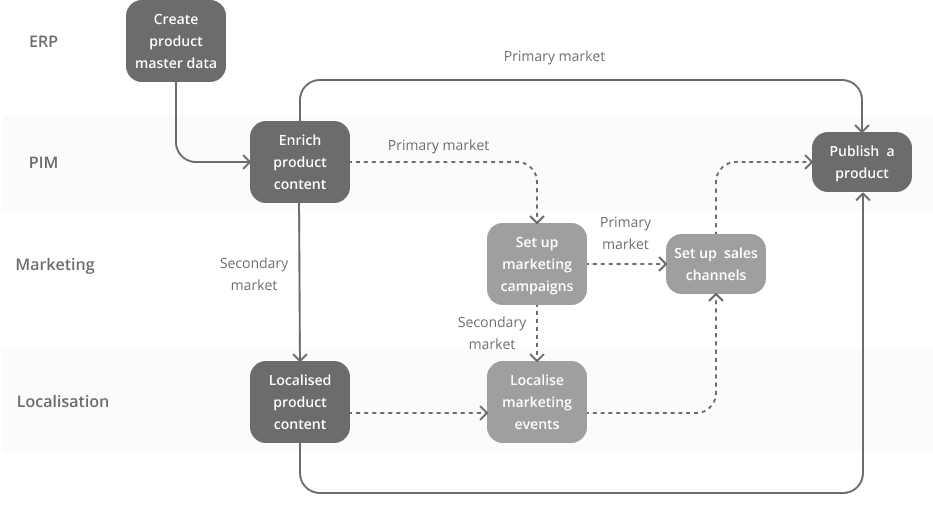
To better understand how the e-commerce operation works across different systems, I mapped two primary workflows to clarify how responsibilities and data move between systems when publishing a product and fulfilling an order.
Publish a product
Fulfil an order

Prototype PIM system services
PIM overview for general product management
The PIM overview page is designed to support the general management of all products. Its main purpose is to enrich and organise the product data imported from ERP, while giving users a clear view of product status, content completeness and localisation progress. With filters for different operational needs, users can more efficiently identify products that require action and manage them across different stages of the workflow.

Centralising product details for scalable localisation
The product detail page centralises product content and related resources into a single source for localisation across secondary markets. Data imported from ERP and supplier sources can be reviewed, completed and enriched before being reused in other markets. AI assistance is applied selectively to long-form descriptions, supporting editors in improving readability while keeping the source content traceable.

What I learnt from the project
System thinking comes before interface design and AI prototyping
While AI can quickly generate multi-functional interfaces for e-commerce management, I chose to first build a grounded understanding of the business context, available resources and system relationships. I learned that clear system thinking provides the foundation for designing operational interfaces, as it helps clarify how different systems, responsibilities and workflows should work together.
Scalability depends on clear system ownership
I realised that when ownership across systems is not clearly defined, conflicts can easily emerge in data flows and system management. Clear ownership creates a more structured foundation for deciding where data should be created, maintained and updated. This also makes the overall system easier to scale as new products, markets and operational needs are introduced.