
Mar-Apr 2026
Product discovery
AI Strategy
Health tech
Exploring AI as a solution for long-term care communication
A product discovery project examining the opportunities and boundaries of AI in family caregiving
My role
Product Designer
Collaborated in a multidisciplinary team of 7 in workshop
Independently refined the case study afterwards
Deliverables
4-day product discovery workshop, followed by independent refinement
Deliverables
Validated product direction for AI-assisted LTC communication
Interactive prototype and usability validation
Challenges
Define an MVP within a complex LTC ecosystem
Balance AI opportunities, user trust and product boundaries
Project process
1
Understand the long-term care ecosystem
2
Interview family caregivers
3
Synthesise research insights
4
Define product strategy
5
Ideate and prototype AI-assisted care solutions
6
Expert review and validation
7
Refine AI experience
8
User validation
Understand the long-term care ecosystem
Taiwan's government projects that the number of people requiring long-term care will increase from 922,948 in 2026 to 1,295,969 by 2035, representing a nearly 40% increase over the next 10 years.
However, the long-term care workforce is already struggling to keep pace with this growing demand. Care workers are increasingly responsible for multiple cases, while case managers face mounting workloads and burnout. As a result, there is an urgent need for digital tools that can improve communication and care coordination.
In collaboration with the Head of the Digital Long-Term Care Department at Mackay Junior College, this project explored opportunities to improve communication between home care providers and family caregivers.
Target specific user segment and journey
The long-term care ecosystem spans healthcare providers, residential care facilities, community care services, home care services and family caregivers. Among these sectors, home care services and family caregivers were identified as the most suitable context for a MVP due to their user needs, business potential, adoption feasibility and opportunities for rapid validation.

Examine the communication flows in the ecosystem
For many families, gaining a clear understanding of a patient's daily care is challenging. Differences in schedules, responsibilities and communication patterns often create information gaps between care providers, family caregivers and family members.
The goal of this product discovery project was to identify where AI could meaningfully support the communication process, while reducing information asymmetry across care settings.

Interview family caregivers
After gaining an understanding of Taiwan's long-term care policies and exploring potential product opportunities, we conducted in-depth interviews with nine family caregivers across eight caregiving families.
These families represented twelve care recipients with a wide range of care needs, including mild physical disabilities, dementia, Parkinson's disease, mental illness, cancer, stroke, and chronic conditions. Two of the participants were sisters from the same family, allowing us to compare how different family members experienced and managed information needs within the same caregiving context.
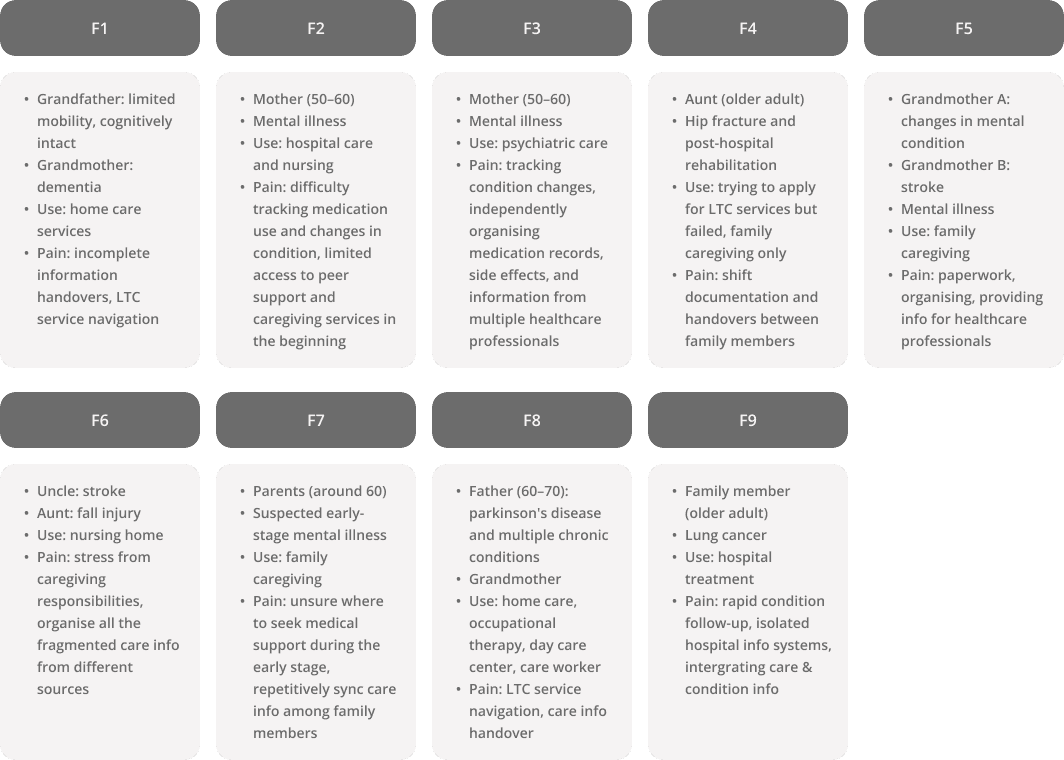
Based on the interviews, four challenges emerged after affinity mapping:
Multi-stakeholder communication (mentioned by nearly - all participants)
Information fragmentation (6 of 9 participants)
Medication and condition tracking (4 of 9 participants)
Navigating long-term care services (4 of 9 participants)
These challenges together created information anxiety and increased the decision-making burden for family caregivers, regardless of the care setting or medical condition.
Define product strategy
After uncovering key insights from family caregivers and care professionals, we began defining the target users for the care communication platform.
The focus of target users is on family caregivers supporting people with mild to moderate care needs under Taiwan's long-term care system. Compared with caregivers of highly dependent patients, this group represents a larger user base, is generally more receptive to digital tools and makes it easier to validate key product hypotheses through an MVP.
The product direction thus centred on one core goal:
Reduce caregivers' information anxiety without introducing additional cognitive load or operational risks.Information
From the main goal, four design principles were developed to guide feature ideation:
Enable seamless care handovers so every caregiver stays informed
Organise care information into clear, prioritised and trustworthy records
Help caregivers focus on what matters most to support better care decisions
Reduce unnecessary cognitive load throughout the caregiving journey
These principles also became the foundation of how I collaborated with AI throughout the project. Rather than generating ideas from scratch, they provided the primary context for prompting AI, ensuring that exploration remained aligned with user needs and product goals.
Turn insights into AI-assisted solutions
During the ideation phase, the proposed features were grouped into four functional areas, ensuring each design decision aligned with the project's core objectives.
Expert review & validation
The first usability test focused on AI-generated daily summaries and alerts as the core product experience. Two professional home care workers in their 50s participated in a one-hour usability test and interview, leading to 4 key findings:
Voice input significantly reduced documentation effort, receiving a rating of 10/10.
Categorised records did reduce the burden to dogest information.
Trust in AI-generated summaries remained limited. Participants viewed them as reference information rather than a reliable source, with an average rating of 5.5/10.
In emergency situations, such as falls or loss of consciousness, caregivers would immediately contact emergency medical services instead of relying on the app.
Redefine AI's role through product decisions
The findings from the first validation led to another HMW:
How might we define AI's role in a way that builds user trust while maintaining the credibility of AI-generated summaries?
Ensure trustworthy information input
After voice transcription, caregivers review and confirm both the recorded content and its categorisation before submission, ensuring the accuracy of the original care record. The original audio and transcripted record stay along with input records as references.

Redefine AI's responsibilities
AI only processes user-confirmed information and automatically generates daily summaries after each new record is added.
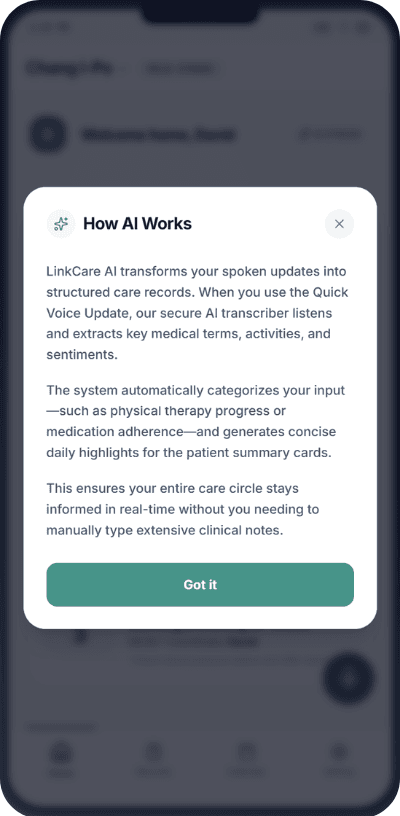
To maintain a clear product boundary, AI is positioned as a documentation and communication assistant rather than a clinical decision-making tool. It does not provide recommendations or make judgments in situations requiring medical expertise, such as emergencies.

AI only organises verified record inputs instead of making further judgement and instructions.

AI integrates new input into earlier records and generates record summary in a clear way.
Improving Information Visibility
Physiological data is visualised to help caregivers understand long-term trends at a glance. Despite the fact that these records were originally intended for healthcare professionals, presenting them visually also makes meaningful changes easier for family caregivers to understand.


Improving transparency
To help users better understand AI's capabilities and limitations, a dedicated page explaining the role of AI was added to the home screen.
Second validation
The second round of usability testing involved 6 family caregivers. Compared with the first prototype, the refined version received higher ratings across all evaluation criteria.
End-to-end experience from voice recording to AI summaries and data visualisation (10/10)
Willingness to recommend and willingness to pay (8/10)
The findings suggest that the redesigned experience effectively reduced information anxiety while improving confidence in daily care communication.
Instead of ending with a finished product, this project concluded with a validated product direction, a refined understanding of AI's role in healthcare and a stronger product foundation for future long-term care innovation.
Takeaway from the project
AI's role evolves with product understanding.
This project introduced me to the concept of AI governance. I realised that AI governance starts with product decisions.
Before deciding how AI should behave, I first had to define where AI should intervene, where it shouldn't and what role it should play within the product. Without careful judgment and a clear definition of AI's role, AI can easily create uncertainty, reduce trust or even mislead users in healthcare scenarios.
AI accelerates execution. Designers define direction.
I treated AI as a collaborative design partner throughout the project, from organising research and prototyping to synthesising validation findings.
While AI significantly improved execution speed, the most valuable design decisions still relied on human judgment: framing the problem, balancing stakeholder needs, making product trade-offs, and defining the product vision.
AI helped me work faster, but product thinking determined product strategy and what was worth building in the end.
AI should not be treated as a default solution but as a product hypothesis to be validated.
This project changed the way I evaluate AI in product design.
Rather than asking "How can we use AI?", I now start with "Does AI create meaningful value in this context?" Only after understanding user needs, business goals and potential trade-offs can AI become a product decision. AI should be introduced because it solves a meaningful problem, not simply because it is the latest technology.